Refrigeration Manifold Gauge: A UK Field Guide for Callouts
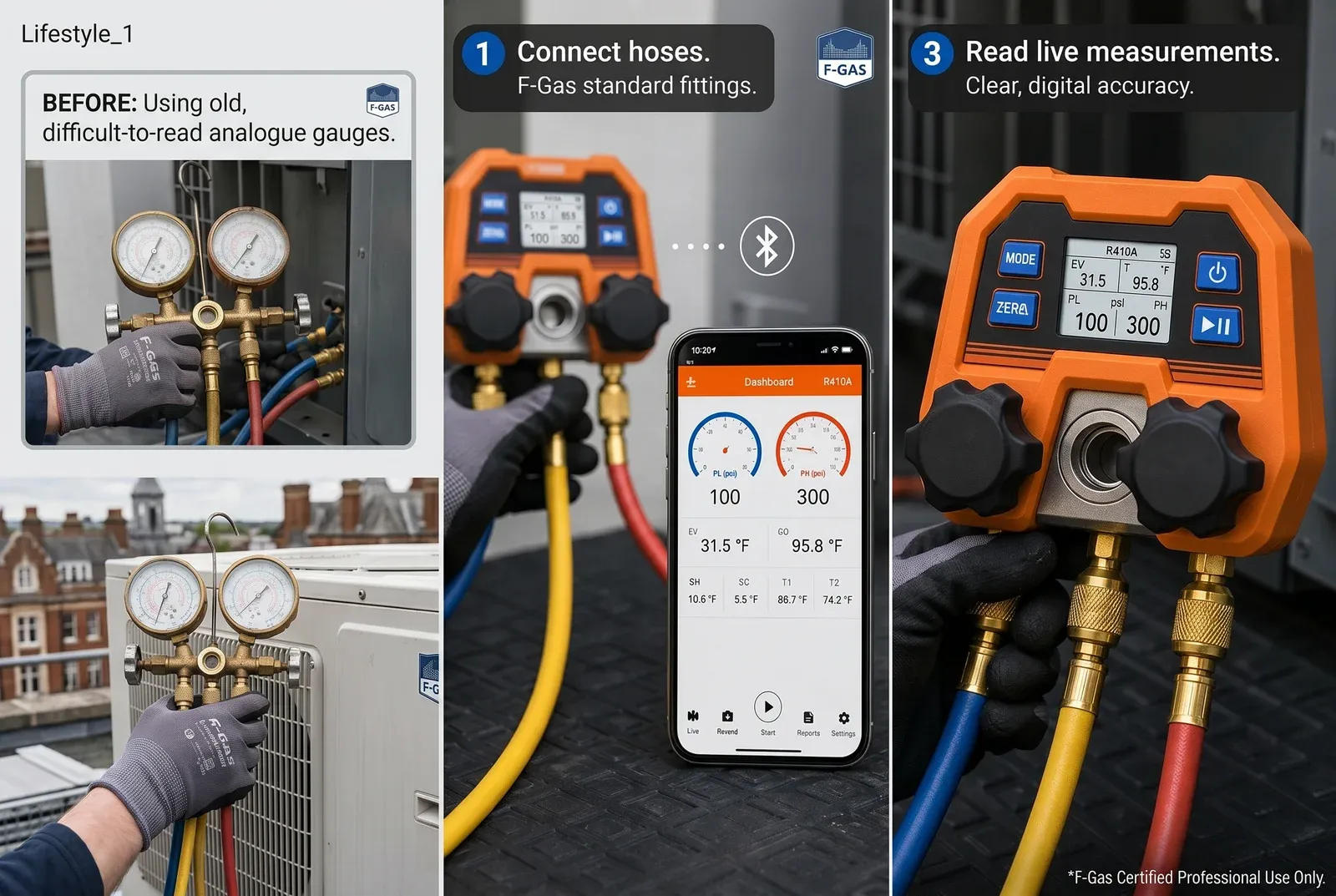
In short: a refrigeration manifold gauge is the gauge set a commercial engineer connects to a system's service ports to read low- and high-side pressure and diagnose a fault. On a cold-room or retail callout that often means working fast in poor light, on systems running R404A, R448A, R449A or R134a. This field guide covers reading pressures under pressure — and where a clear digital set helps most when stock is warming.
Callouts rarely happen at a convenient time or in a well-lit room. You arrive to a warming case or a cold room that has tripped, and you need a trustworthy read of the high and low side quickly. The notes below use the ManifGauge Elitech DMG-4B digital manifold gauge as a reference, but the method is the same on any set.
What a refrigeration manifold gauge does
The manifold reads two pressures: the blue low-side gauge on the suction line (evaporating pressure) and the red high-side gauge on the liquid/discharge line (condensing pressure); the yellow centre hose handles vacuum, recovery or charging. Converting those pressures to saturation temperatures for the refrigerant lets you check superheat and subcooling and find the fault. The fundamentals are set out in our HVAC manifold gauge guide if you want the theory in one place.
Reading pressures on commercial refrigeration
Commercial systems in the UK commonly run R404A, R448A, R449A or R134a. Several of these are blends with temperature glide, which changes how you read the chart:
- For superheat, use the dew-point (vapour) column at your suction pressure, then subtract that saturation temperature from the measured suction-line temperature.
- For subcooling, use the bubble-point (liquid) column at your head pressure, then subtract the measured liquid-line temperature from that saturation temperature.
- Don't judge charge on suction pressure alone — a low reading can come from low load, airflow or a restriction. Confirm with subcooling.
Because you may move between several refrigerants in a shift, selecting the wrong pressure-temperature relationship is an easy mistake to make on a mechanical set with printed scales. A digital gauge that stores 90+ refrigerant profiles lets you pick the right one on the spot and reduces that risk.
The dark plant room problem
A classic callout frustration is reading a needle against a crowded scale by torchlight in a cramped plant room. A clear digital display is far easier to trust at a glance in poor light, which is exactly when a misread costs you time you do not have while the stock temperature is climbing.
One engineer, condenser and case far apart
On many sites the condensing unit is on a roof or in a separate space from the case or cold room you are diagnosing. Working single-handed, you lose time walking between the two to see how the system responds. Pairing the gauge to your phone lets you watch the pressures from the app at one end while a colleague — or you, after making a change — observes at the other. The app-connected side is covered in our smart manifold gauge guide.
Keep the callout moving
A set that dies mid-shift, or gets damaged in the van, can stop a callout dead. The DMG-4B is £170.79 inc VAT (£142.32 ex VAT) and ships next day from the UK with a 30-day returns window, so a replacement or spare can reach you before your next run rather than leaving you improvising. Against premium brands such as Testo or Fieldpiece, you trade some ecosystem extras for a lower price and quick UK availability — worth weighing if you cover a lot of sites.
Honest boundary
A manifold gauge diagnoses pressures; it does not measure airflow, electrical faults or line temperature on its own — you need temperature clamps for superheat and subcooling. On glide blends, remember the dew/bubble distinction or let a digital set apply it. Bluetooth can drop through thick plant-room walls, so keep the phone in range and expect the odd re-pair. And handling these refrigerants is F-Gas work under the GB regulation enforced by the Environment Agency: certification, leak-checking and record-keeping still apply, whatever gauge you use.
Common questions on callouts
Which refrigerants should a refrigeration manifold gauge cover?
For UK commercial work, at least R404A, R448A, R449A and R134a. A digital set with 90+ profiles covers these and the AC gases (R32, R410A) you may also meet.
Why does my low-side reading look low?
Low suction pressure can be caused by low load, poor airflow or a restriction, not just low charge. Check subcooling before adding refrigerant.
Can I monitor pressures remotely on a large site?
Yes, with an app-connected set you can watch live readings from your phone, which helps when the condenser and the case are far apart.
Kitting out for callouts?
Shop the Elitech DMG-4B — £170.79Free UK next-day delivery · CE/UKCA/RoHS · 12-month warranty · 30-day returns